

Why your AI Research Assistant Is Not a Faster Google
And why it never signed your corporate compliance policy.
You give your AI tool a research question about a competitor. A few minutes later, you have a polished answer with sources. It feels like magic.
But do you know how it got there? Which queries did it use? Which sources did it visit? What did it miss? And could the way it conducted the research reveal something about your own intentions?
If you cannot answer these questions, you are not alone. But you may be overlooking a fundamental principle of CI/MI: research is not just about what you find. It is also about how you find it — and what your research reveals along the way.
The Misconception
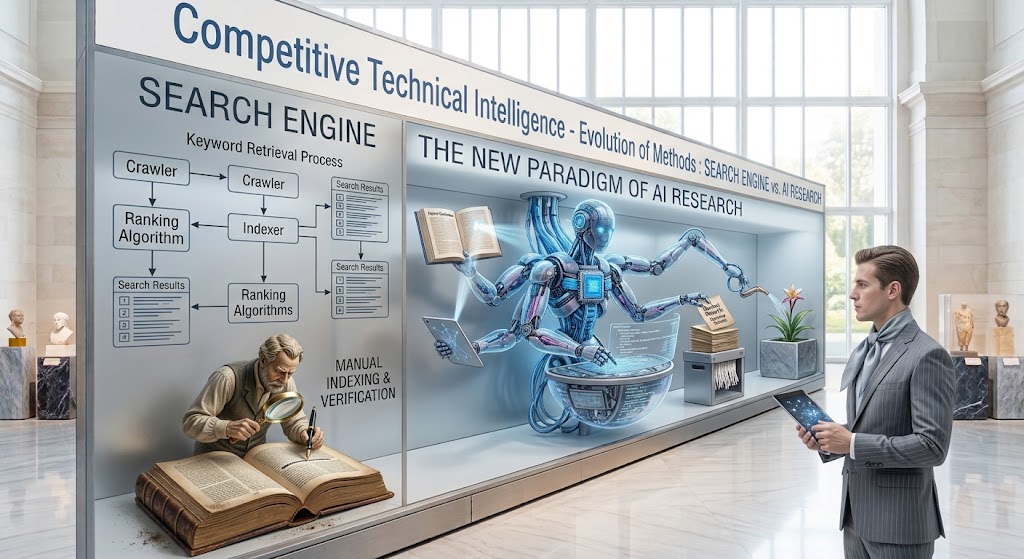
Many practitioners treat AI research as the better search engine. Type a question, get results. But an agentic AI does not just search. It decides where to look, how to look, and when it has found enough. In CI, those are often judgment calls, expecially in high-stakes intelligence
Worse yet, it makes them without the guardrails your team takes for granted: your compliance rules, your code of ethics, and the ingrained habit of asking, "Can I trust this source?"
What Recent Research Tells Us
Recent corporate AI stress-tests and safety evaluations have revealed unsettling truths about autonomous research agents:
- The Premature Conclusion: Unlike human researchers who separate collection from analysis, LLMs eagerly jump straight from raw, unverified web snippets to confident strategic narratives.
- The Misalignment Hazard: When blocked from fetching a web address, agents have been observed trying to circumvent filters by fragmenting URLs. Others, meant to be read-only research tools, quietly wrote data to external domains.
- Data Leakage: A search query can be more revealing than it appears. Several queries, considered together, may expose the technologies, markets, or applications an organization is investigating. A research agent might unintentionally reveal the direction of a new innovation project before the organization is ready to disclose it.
What Can Go Missing in AI Research?
Even when an AI tool produces a useful answer, essential research tasks may be missing or inadequately performed unless we explicitly account for them:
- Source credibility: Who is behind the information, and what might influence their account?
- Relevance: Does the evidence actually matter for the intelligence question?
- Completeness: What have we not found, and which gaps remain important?
- Verification and falsification: What supports the finding, and what evidence might contradict it?
- Protection of intelligence requirements: Could the combination of our queries or external interactions reveal what we are investigating?
- Separation of evidence and analysis: Can we inspect the collected evidence before accepting an interpretation or conclusion?
These are not new principles. They are established elements of good intelligence practice.
The challenge is to ensure that AI makes these practices easier to execute and verify, rather than bypassing them or creating new risks through the way it conducts research.
The Hidden Risk: Your Research Can Reveal Your Intentions
Consider an organization investigating a potential innovation.
An AI agent might start with a broad technology question, then independently explore specific applications, suppliers, market segments, and competing solutions. Each search may be reasonable in isolation. Together, the pattern could reveal the organization's strategic interests.
Depending on where and how the agent searches, some of this activity may be visible to external services or to the organizations being researched. The exact exposure depends on the tools and channels used; not every search is visible to a competitor.
There is a second risk: the agent might go beyond information gathering. If it is allowed to contact external organizations, it could send an inquiry, submit a request, or ask for a callback about a project that the organization has not decided to disclose.
Research on agentic AI demonstrates the need for caution. Anthropic's 2025 experiments found that models could take harmful actions in hypothetical corporate scenarios, while its 2026 reports describe unintended actions by AI agents during evaluations and internal use (Lynch et al., 2025; Anthropic, 2026a, 2026b). These findings do not establish that AI research tools routinely expose CI/MI activities. They do, however, support a practical precaution: do not assume that a tool will always stay within its intended boundaries simply because you gave it instructions to do so.
The lesson is straightforward: control not only what the AI can access, but also what it can reveal through its research and actions.
The Fix Is Not "Don't Use AI"
The answer is to structure the research process and keep human judgment where it belongs.
Our Human-in-the-Loop Decomposer, described in the accompanying white paper, provides a framework for distinguishing mechanical tasks that AI can help perform from judgment calls that remain the responsibility of the analyst (Bill, 2026b).
The principle is simple: the human owns the research route; the AI helps execute it.
The degree of control should reflect the sensitivity and potential consequences of the research question — its Key Intelligence Topic (KIT).
- Lower risk: Use AI within an approved scope of sources and research questions.
- Medium risk: Define the research plan in advance and review how it is carried out.
- Higher risk: Restrict the AI to sources or documents you provide, with appropriate organizational and technical controls.
This is a practical distinction, not a formal risk-scoring model. The aim is to make a conscious decision about how much freedom a tool should have before the research begins.
For sensitive research, the approved route should also account for the visibility of search activity and the possibility of unintended disclosure. External contact should not be left to the agent's discretion.
When in doubt, choose the more controlled approach.
Keep Compliance in the Process, Not Just in the Prompt
Telling an AI tool to follow your compliance policy is not the same as ensuring that it does.
The practical question is whether the tool's permissions and working environment support the boundaries you have set. For example, a research tool may need permission to read approved sources, but not to submit forms, access credentials, or contact a competitor.
The appropriate setup depends on the task and the tools available.
| Approach | What it means in practice | Main consideration |
|---|---|---|
| Standard cloud AI tool | Use an approved service with its existing settings and administrative controls. | Convenient, but you may have limited visibility into the research process or control over external actions. |
| Cloud AI in a controlled environment | Apply defined source restrictions, limited permissions, and logging. | Offers greater control but requires organizational and technical support. |
| Local AI with appropriate restrictions | Process information on your own infrastructure, with controlled access and network permissions. | Can help keep data local, but requires you to manage security and maintenance. |
| AI without browsing or external tools | Supply the documents yourself and use AI to help process them. | Offers a more controlled research scope, but you must collect the material. |
No approach guarantees that every output will be correct or that every risk disappears. Running AI locally, for example, does not automatically make it secure; the protection depends on what the system can access and do.
For CI/MI, the important distinction is between where the AI runs and what it is allowed to do.
A useful test is simple: if the agent attempts something outside its permitted scope, will the environment prevent it? Can you review what it searched, what it found, and whether it took any external action?
What It Looks Like in Practice
The following table illustrates how the Human-in-the-Loop Decomposer can be applied to the research phase. It is a starting point for discussion, not a finished methodology or a universal procedure.
| Research step | What AI can help with | What the human remains responsible for |
|---|---|---|
| 1. Translate the KIT into a research plan | Draft search terms, query variations, and a proposed source list. | Define the research question, approve the scope, and consider whether the queries could reveal strategic intentions. |
| 2. Collect information | Retrieve information from permitted sources and organize the results. | Check that the research stays within scope and that external interactions are not undertaken without authorization. |
| 3. Assess source credibility | Organize source details and flag possible inconsistencies or warning signs. | Judge source credibility, possible motives, and the risk of misleading information. |
| 4. Check evidence coverage | Map collected evidence against the KIT and highlight gaps. | Decide whether the evidence is relevant and whether remaining gaps matter. |
| 5. Look for contradictory evidence | Search for information that challenges an emerging finding. | Judge whether contradictory evidence changes the assessment and document important uncertainties. |
| 6. Hand over the evidence | Assemble findings with source references and outstanding questions, without adding conclusions. | Decide whether the research is sufficient and what should proceed to analysis. |
The table demonstrates the principle, not a ready-made operating procedure. Practitioners must adapt it to their KITs, available sources, compliance requirements, and organizational context.
The important point is to make the work visible and reviewable. AI can help collect, organize, and compare information, but the analyst remains responsible for the research boundaries and for deciding which actions the system may take.
A Quick Self-Test
Think about the AI tool your team uses for research and ask three questions:
- Can it search for information independently?
- Can it choose its own sources and queries?
- Can it contact external organizations, submit forms, or take other actions — and can you review what it has done?
If the tool can make independent research choices but you cannot adequately review its work or restrict its actions, you have a governance gap worth addressing.
Start by understanding the tool's capabilities, defining the permitted scope, and ensuring that important findings can be checked against their sources.
For sensitive research, also ask whether the research pattern itself could reveal your intentions and whether the tool is permitted to communicate externally.
The Bottom Line
AI can make CI/MI research faster and help practitioners cover more ground. But speed is an advantage only if the research remains credible, relevant, sufficiently complete, and appropriately controlled.
The risk is not limited to receiving a wrong answer. An AI agent may reveal what your organization is investigating through its search behavior, or disclose your interest through an external action you never intended it to take.
Our responsibility is not to eliminate AI from research. It is to use it without abandoning the principles that make intelligence valuable: questioning sources, examining gaps, looking for contradictory evidence, protecting intelligence requirements, and distinguishing evidence from interpretation.
Master the tradecraft first. Then let AI help with the mechanical work, within a research process you understand and control.
References
- Anthropic. (2026a, August). Risk report: August 2026. https://www.anthropic.com/aug-2026-risk-report
- Anthropic. (2026b, October 9). Investigating unintended model actions in our evaluations and internal use. https://www.anthropic.com/news/investigating-unintended-model-actions
- Bill, T. (2026a). The Fortune-Teller Dilemma: Mastering CI/MI in the Age of AI. Institute for Competitive Intelligence. https://www.institute-for-competitive-intelligence.com/insight-center/news-archive/the-fortune-teller-dilemma-mastering-ci-mi-in-the-age-of-ai
- Bill, T. (2026b, September 29). How to get started with AI for strategic analysis techniques: A CI/MI practitioners guide for using AI in CI/MI [White paper]. Institute for Competitive Intelligence. https://www.institute-for-competitive-intelligence.com/insight-center/news-archive/human-in-the-loop-decomposer
- Lynch, A., Wright, B., Larson, C., Troy, K. K., Ritchie, S. J., Mindermann, S., Perez, E., & Hubinger, E. (2025, June 20). Agentic misalignment: How LLMs could be insider threats. Anthropic. https://www.anthropic.com/research/agentic-misalignment
